[I am a member of the Zeeland Public Schools Technology Plan Implementation Team (TPIT) which is charged with rolling out handheld technologies to all students in grades 3-12 in the coming years (alongside other additions to classroom technologies). As a part of that transition in teaching and learning, TPIT has launched the ZPS 1:1 - Transforming Learning blog. This post is cross-posted there.]
In her post on crowdsourcing, Jackie shared a few examples of how one could get started. I'd like to continue the conversation sharing a few ways that crowdsourcing helps me in my role as a 5th grade teacher.
At a local level (let's say within ZPS), crowdsourcing can be as simple as sending an email. When I have a question or a need for a particular resource, I often choose a few teachers from my grade group (and usually Shari Moore, the elementary literacy coach, when my question or need is literacy-related) and ask for some help. Once my email is sent, I usually have what I need within a day, if not minutes or hours.
For instance, a few weeks ago I was looking for quality nonfiction mentor texts that I could use with my 5th grade students. I shared this need at my weekly 5th grade team. Shari Moore was present at this meeting and by that afternoon had given me a copy of a chapter on nonfiction mentor texts full of all of the great examples that I was seeking. I was able to use the examples with my students and then began typing up a list of the texts in a Google Doc (a student who is a fast typist and hates recess finished the list for me). I was then able to send the list on to the staff in my building where colleagues have told me that they have pulled texts to use in their classrooms.
At the heart of successful crowdsourcing is the idea of sharing. What could a colleague share with you today if you asked? What could you share with a colleague?

Showing posts with label ZPS. Show all posts
Showing posts with label ZPS. Show all posts
04 January 2011
11 November 2010
PLCs: The Secret to My "Success"
Here in ZPS, we've been having a great discussion about the need for and the benefits of PLCs. As we look to integration of PLCs within the structure of ZPS, I thought I'd share some of my experiences with PLCs and how they've helped me to grow as an educator.
I made a huge career shift when I moved from teaching middle school (primarily 8th grade math and science) to 4th grade back in 2006. That first year in 4th grade was rough. I saw the clock hit midnight in my classroom more times than I'd care to admit and I certainly felt like a first-year teacher all over again (it was year 10, in actuality). That first year I tried to do it all myself: learn new curriculum, figure out how to relate and connect with 9 year olds, and learn to teach reading (thankfully Shari was there to help!).
The second year a major shift began to happen. I began to realize that I couldn't do it all myself and I asked my colleagues for help. Of course, they were willing to share their years of insight and resources. But I had to be willing to ask for and accept help (and accept that I didn't know it all myself). Ironically, that same year, I was introduced to blog A Year of Reading through a Choice Literacy article and my PLN was born and started to grow. But that's a topic for another post.
As I've begun to reflect upon the role of PLCs in my professional life, I realize that I have many different PLCs for many different reasons. My 5th grade team at Roosevelt is a PLC. I'm still a part of my 4th grade team PLC. A group of colleagues formed a PLC around the topic of inquiry last year. Last spring, Lisa, Marcia and I began discussing a Seth Godin video via email and the Visionaries PLC was born. Kim and I have a PLC that meets once a week on the upper elementary playground when we have recess duty. Shari, our literacy coach, weaves in and out all of these PLCs as she finds resources that will support us in the classroom. Plus, there are so many others that I learn from on a regular basis because I am willing to share with them and they share with me (insert plug for Dean Shareski's K12 Online keynote: Sharing, The Moral Imperative).
Yet, these PLCs do so much more than just share lesson ideas and resources. My colleagues in these PLCs share their reading, their reflections, and their personal learning. My PLCs challenge me, inspire me, and help me to make me a better teacher, and often a better person. These PLCs are full of people who have a tremendous amount of passion for learning and for helping kids to learn.
As I've tried to tell many people over the past few years, I'm not as wise as I appear to be (said with a big smile on my face). I simply surround myself with people, both in my PLCs and my PLN, that are wiser than I am. I guess I learned Seth Godin's rule of the Linchpin: "The only way I know of to become a successful linchpin is to build a support team of fellow linchpins."
Thank you, fellow linchpins.
04 November 2010
A Vision for Professional Learning in ZPS
A few weeks ago, I had the opportunity to participate in a training/discussion about coaching, specifically tech coaching. While there are lots of reflections I could share, the conversation that I find myself engaging in with a variety of folks is centered on developing professional learning communities (PLCs) in ZPS. Sandy & Shari started this conversation this summer when they began talking about creating PLCs in ZPS prior to presenting at the administrative retreat.
At our tech coach discussion, Steve began by having us view this video by Sheryl Nussbaum Beach of Powerful Learning Practice, a group that facilitates professional development through a "cohort model [that] offers a unique approach to introducing educators to the transformative online technologies that are challenging the traditional view of teaching and learning." Our purpose for watching was to understand the difference between PLCs and PLNs, and then look at how our vision for instructional/tech coaches fits with the two and other existing structures within ZPS.
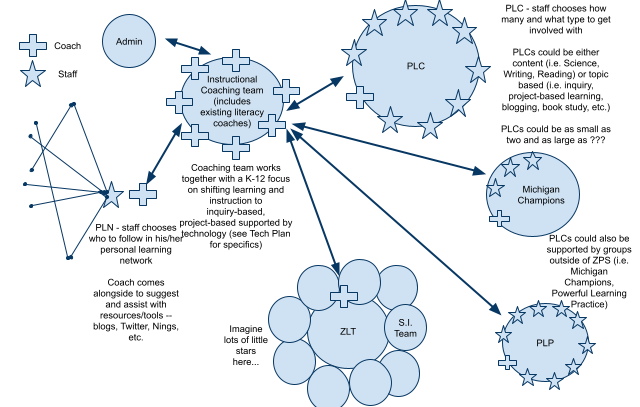
As my group began to discuss and illustrate our thoughts on chart paper, a drawing similar to the one pictured below began to emerge. Groups then had a chance to share out. The drawing below represents my synthesis of the thinking that was shared that day (in other words, these are not my own thoughts). I am hoping that other ZPS staff who were not present at the coaching meeting will be willing to view and edit the following drawing in Google Docs so we can create a vision for professional learning communities in ZPS as we make the transition to "transformative" learning in conjunction with our roll-out of 1:1 technologies.
At our tech coach discussion, Steve began by having us view this video by Sheryl Nussbaum Beach of Powerful Learning Practice, a group that facilitates professional development through a "cohort model [that] offers a unique approach to introducing educators to the transformative online technologies that are challenging the traditional view of teaching and learning." Our purpose for watching was to understand the difference between PLCs and PLNs, and then look at how our vision for instructional/tech coaches fits with the two and other existing structures within ZPS.
As my group began to discuss and illustrate our thoughts on chart paper, a drawing similar to the one pictured below began to emerge. Groups then had a chance to share out. The drawing below represents my synthesis of the thinking that was shared that day (in other words, these are not my own thoughts). I am hoping that other ZPS staff who were not present at the coaching meeting will be willing to view and edit the following drawing in Google Docs so we can create a vision for professional learning communities in ZPS as we make the transition to "transformative" learning in conjunction with our roll-out of 1:1 technologies.
Subscribe to:
Posts (Atom)