Showing posts with label Random thoughts. Show all posts

02 July 2013

"Waking from cancer..."

"Waking from cancer, I fell into an unexpected loss of ambition, and the milestones by which I wanted to engrave my image on the world scattered." 

- Mark Nepo, Seven Thousand Ways to Listen, p. 47
Chloe, tubing the Platte River last week.
My six-year-old daughter, Chloe, was diagnosed with a stage III Wilm's Tumor two years ago this week. Thanks to God, she's doing great. 

The changes that the arrival of cancer brought to our family were immense, innumerable, and life-altering. While we would never invite cancer into our family, my wife and I can readily cite hundreds of positive changes that it brought to our family. Life-threatening illnesses have a way of doing that.

Yet, from my vantage point, my working world has never quite recovered. Maybe that's why the quote from Mark Nepo resonated with me this morning. In so many ways I feel like my pre-cancer goals, my milestones, disappeared and I've spent the past two years trying to figure out where I'm headed professionally.

However, I've begun to wonder if it's okay to not know exactly where I'm heading. Maybe it's okay to just show up each day, ready to learn, ready to question, ready to listen. Present to the possibilities.

13 June 2012

"What now?"

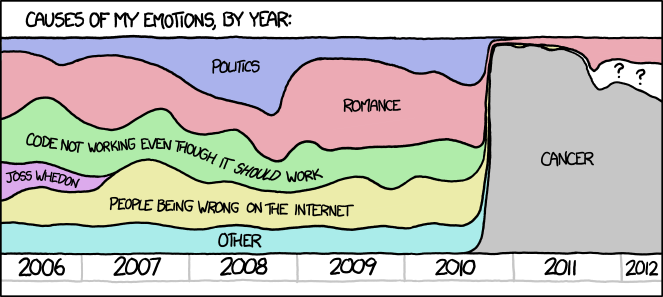
A while back, a friend shared this comic with me.

Emotion by xkcd
Substitute a few of the pre-cancer "causes" and shift the arrival of cancer a year forward and it could be my emotions.

As my daughter's chemo treatments wrapped up early in 2012 the white area with the ?? began to grow.  Life pre-cancer was just life, it wasn't perfect, but it was. Life post-cancer is different, time feels more precious. (She's doing great, by the way.)

The white space has been filled with a fuzzy attempt to discern where my energies should be spent, what should be my focus, what is worthy of my time now that it feels more precious.  

But it's been too much thinking, not enough living.  I believe that something new, something amazing, something creative will come out of our family's experience.  Yet I'm having a difficult time waiting to see what that something is...

Random stories have appeared out of nowhere to encourage me to just move on, to live, to do.

I recently learned an adventure photographer whose work I've admired for years experienced cancer at a young age and was touched by the way his view of community changed.

A colleague shared how his career path changed following a family tragedy.

Yesterday it was Rob Bell's Drops Like Stars that jumped off the bookstore shelf and resonated in my soul as I read:
Others with far more wisdom and experience than me have tackled the "why" questions of suffering.

Here, in these pages, I'm more interested in another question...

Not "why this?"
But "what now?"
He goes on to write: "[Suffering] compels us to eliminate the unnecessary, the trivial, the superficial."

I can see that in our family's life, in the way that we've reordered our priorities and the new ways we use our resources of time, energy, and money.

Rob continues with this observation:
Sometimes what happens to us when we suffer is that we become open to the mercy and grace and gratitude and gift and appreciation and joy that are always around us all the time...
While I wait to see "what now?" I'd be content if I could be open to what is, and always has been, all around me.

06 October 2011

Prayer & Inspiration

"How are you guys doing it?"

I can't tell you how many times my wife and I have been asked that question in the months since Chloe's diagnosis.  The answer is simple.  You get up, you get going, you get the family going, and just live the day.  You don't have a choice.

Actually, I've found there are two things that are making days manageable.  Prayer and inspiration.

Prayer is the obvious one.  However, I've found there are so many days when it is difficult to quiet my mind and heart and allow the Spirit to enter the moment.  Yet it is on those days that others tell me, from seemingly out of nowhere, that they are praying for Chloe and our family.  Today is was a colleague during my plan time, over the weekend a parent of one of my students told me that my student prayed for Chloe during Sunday School. Wow.

The inspiration piece is something that evolved as I was trying to expand my circle again.  In an effort to get back into my PLN, I began to give myself five minutes a day to explore Flipboard containing my Twitter and Google Reader feeds.  Not only did I begin to feel inspired again, I began to want to share that inspiration either through a tweet, an email, or a conversation.  A daily ritual had begun.  Now each day, without planning or forethought, I carve out a few minutes to be inspired or inspire someone else.

And that, possibly poorly written, is how I do it each day.

27 September 2011

An expanding and shrinking circle

Circle inversion by fdecomite on Flickr
[I have a few posts that don't really fit here, but they don't fit on the family-turned-Chloe-update blog.  As work, family, and life are closely integrated right now I'm going to post them here.  I'm feeling the need to write.  Thanks for understanding.]

When Chloe was first admitted to the hospital this summer, my world, or my circle, shrunk to five people - our  family.  Many days it was a circle of three as Henri and Martha were cared for by grandparents, aunt and uncles, or family friends.

In the weeks following, it was challenging to expand that circle.  It went slowly, sometimes trying to include a few friends from church or colleagues from work.  Often times I found myself needing to retreat to my circle of five afterwards to regroup and recharge.

It took at least a month and a half before I was able to expand my circle great enough to include my PLNs via Twitter and Google Reader again.  Even then, most of the time it is still as a "lurker" rather than as a participator.

Last week, Chloe had a tough week.  A heavy dose of chemo on Monday made her feel cranky, tired, and generally out of sorts for the week.  That determined our week as well.  Couple that with a lot of assessments within the walls of my classroom and I have found my circle shrinking again.  

I wonder if this expanding and shrinking circle phenomenon is just a product of cancer in our family or if it has happened before without my awareness.  One more detail that I just need to accept and roll with...

15 May 2011

When the going got tough...

...to be honest, I wanted to quit.

Since Christmas Break I've been trying to get back into the running groove. Unfortunately, beginning about that same time, I began to suffer from painful IT band issues. In an effort to keep myself motivated to get out there and pound the pavement, I signed up for the 25K Riverbank Run. A little nutty, I'll admit. Yet I knew that if I didn't have that out in front of me, I probably would have quit. And boy did I want to quit.

On at least three occasions (and probably more), I came home and told Christa that I was done running. It was time for me to be content walking and cycling. She did a great job of just listening, and then usually suggested to take a few days to recover and then try it again.

Towards the end of March when my mileage was about half what it should have been according to my training schedule, I discovered that I had overlooked one possible contribution to my IT band pain: insoles. Even though I replace my shoes on a regular basis, I hadn't replaced my insoles for many (read: around 5!) years. Once I put new insoles in my shoes, the pain started to go away.
Yesterday, I achieved my goal: I finished my 25K run with a smile on my face. The run was great. Lots of energy, the rain stopped just in time for us to start, and the temperature was perfect. No record time, but I feel great about my effort.

Without going into too many details, I see so many parallels between my efforts to train for my run and the work of the ZPS TPIT. I was reminded of that as I finished up reading Switch: How to Change Things When Change is Hard yesterday afternoon. Two quotes from the final pages resonated with me:

Change isn't an event; it's a process. (p.253)

To lead a process requires persistence. (p. 254)
My run yesterday was certainly an event, but it wasn't the change. The change is my getting back into running. Likewise, handing our staff and students new technology in the coming months will be an event, but the technology itself won't create a transformative change. That change is going to be a long process, one for which we will be persistent.

31 January 2011

Learning can — and must — be networked

Over the weekend, I shared the EduCon Conference's axioms with the TPIT Diigo group which included the statement: Learning can — and must — be networked.

I've often described my experiences with learning within social networks as serendipitous. I never know what will pop up on Twitter, in my Reader, in my Diigo groups, or, as it occurred today, even in Goodreads. I don't even usually consider Goodreads when I name the social networks I use. I started using it because my brother uses it and it was a fun way to keep up with his reading and to share my reading as well.

A few weeks ago my Goodreads account was followed by Paul Reynolds, the brother of Peter Reynolds (author of Ish, and other excellent books). I'm guessing he connected with my account because I had marked several of Peter's books as read (but to be honest, I don't really know). Today, Paul shared a review of The Big Picture: Education is Everyone's Business written by Dennis Littky and Samantha Grabelle.

In his review, Paul wrote:
If we move to a model that is student-at-center/teacher-at-periphery within a distributed learning community (one that, as Chris Dede states would, "enable a shift from the traditional transfer and assimilation of information to the creation, sharing and mastery of knowledge."), the teacher has TIME to take on the mentoring role. Educators would no longer have to scramble daily to be the fully-stocked "information vending machine" - rapidly dispensing knowledge to "cover" content standards/requirements - instead they could focus time and energy on knowing their learners.
While I'd love to head off on a tangent and share how I see this as one of the benefits of 1:1 and student-centered learning that we're trying to achieve, I'll practice what I preach to my students and stick to my topic.

For me, much of my learning occurs when I simply show up in one of my networks. Thankfully there are others out there who are sharing what they are learning and trying with their students. What can you do today to facilitate learning for yourself? Is there a social network that you've been curious about trying out? Give it a try and see what happens.

27 October 2010

Practicing Empathy

In a recent post, Will Richardson shared a video of a discussion between himself and Lisa Brady, the superintendent of the district he was formerly employed by and where his kids now attend school. It was a great discussion about the challenges and successes of going 1:1 and the realities of introducing social networking. As Will writes, "I think it’s great opportunity to hear a school leader in the midst of shifting a traditional school to a inquiry-based curriculum grounded in technology and online social learning tools talk about some of her thinking around making those changes."

I highly recommend viewing it.

As I've been thinking about the big shift that is occurring and talking about it with colleagues, I'll admit that I don't always remember to practice empathy and put myself in their shoes. In a comment on the same post from Will, Susan Davis wrote the following:

I am struck by your (our) frequent use of the word “shift.” To many, I think it feels more like a quake. Even as a quake, the earth moving under our feet — the change in the way learning is happening in the world — can make us feel excited (hey, that’s cool, I wonder what that shaking means…) or it can feel pretty scary (hey, my house is falling down around me).

This conversation reminds me to feel a little more empathy for those whose educational houses are falling down around them.

When Lisa Brady asks, as if for those scared and shaken folks, “Where’s my entry point?” we can imagine how they are seeing a world where the doors are moving side to side so fast they can’t see beyond them. Still, there is some urgency, the ground is shaking, and they need to get through one of those passages and safely to the other side.

It was a good reminder to me to practice empathy with my colleagues "whose educational houses are falling down around them."

19 September 2010

Thinking "Ish-ly"


Last Tuesday, my fifth grade students and I shared a reading of Peter Reynolds' Ish. The book tells the tale of Ramon who loves to draw, but, after his older brother Leon makes fun of his drawings, begins to believe that he can't draw well. Thankfully, Ramon's younger sister, Marisol, helps him to see his drawings differently and he begins to see the "ish-ness" in everything around him.

My students had heard Ish last year when my fourth grade colleagues and I read it at the beginning of the year as a part of our community building. That fact didn't deter their enthusiasm of sharing their thoughts while I read it, or in discussing what working "ish-ly" in our class would look like and how we would need to support one another in order to work "ish-ly."

Some of you may know that I moved from teaching fourth grade to fifth grade this year. Our building went from three sections of fourth grade to two, so someone had to make the switch. I didn't think it would be a big switch. I am in the same classroom, have a third of my same students, and felt like we could just pick up where we left off last year. In many respects, I was correct. My students from last year jumped right into the same routines and have helped those who are new to my classroom. Yet, my standard line from the past week is that "I severely underestimated the amount of work that goes into switching grades."

To summarize the state of my being early last week, I would simply say I was stressed. Nothing seemed to be working, I seemed to be falling behind in everything, and I felt like I had lost the art of teaching. Then on Wednesday, it hit me. I was like Ramon. I felt like I had Leon looking over my shoulder all day, making comments about what was happening in my classroom. I couldn't think clearly because my brain was in a state of panic wondering how I was going to ever recover from this switch.

So, I began to think "ish-ly." I gave myself permission to not know every little detail of 5th grade curriculum at the present time, permission to take things step-by-step, permission to make a pile of items to get back to at another time. Suddenly, everything fell into place. Looking back, I'm sure everything was going along fine before my thinking "ish-ly." All of those "seemed" and "felt" emotions from the previous paragraph were simply in my head. Yet, it took a little book to remind me to stop being a perfectionist and to look around and see the "ish-ness" in my students and my work.

If you're in the world of education, I hope that this finds you well in the new school year. If you happen to be feeling swamped by it all, I encourage you to pick up a copy of Ish. Maybe with a little "ish-ful" thinking you'll find you're doing quite well.

21 July 2010

Secrets of Being a Linchpin

There are many characteristics of a linchpin that I can relate to, but I'll spare you my self-analysis. Instead I'll let you in on two secrets on being a linchpin courtesy of Seth Godin.
"The law of linchpin leverage: The more value you create in your job, the fewer clock minutes of labor you actually spend creating that value. In other words, most of the time, you're not being brilliant. Most of the time, you do stuff that ordinary people could do."

"The only way I know of to become a successful linchpin is to build a support team of fellow linchpins."

19 July 2010

Linchpin


I picked up a copy of Linchpin by Seth Godin at the library a few months ago after I noticed several others reading it and mentioning it. I've only read through a few chapters whose titles grabbed my attention, but what I've read has been thought-provoking, challenging, and inspiring. With it being summer much of my reading has been in small chunks in many different locations (several different states) and I've lost track of a lot of my thoughts that I wanted to post. So, you'll just have to read it yourself. :>) I'd recommend "Becoming the Linchpin" for starters. "The Culture of Connection" is great as well with a confirmation of all of the collaborative work that we do.

I guess what has struck me the most in my reading is both how necessary it is for me to be a linchpin in my role as an educator and how my own kids and my students will need to be linchpins to succeed in the changing world of work.

If anyone else is reading or has read Linchpin, I'd love to discuss it with you.

01 May 2010

Searching for artistic inspiration

[A few weeks ago, I gave myself permission to post random, incomplete thoughts. This looks to be one of those.]

Over Spring Break, C. (my wife) and I browsed through a local gallery and talked about the idea of incorporating more art into the life of our family. We discussed the idea of a making a place for our kids to create art that we could use alongside them.

Along with having a place for art, I talked about the idea of finding sources of artistic inspiration. I set out to find a few blogs that may provide a little daily inspiration. Thanks to a friend and colleague of C.'s (who is also an amazing photographer), I began following the Herman Miller Lifework blog. In the past month I have enjoyed being exposed to talented artists and inspiring workspaces.

One of my colleagues frequently mentions the work of Daniel Pink so last weekend I checked out A Whole New Mind (AWNM) from the library. I was captivated from the first page. I have since jumped ahead to his chapter on Design. In it, he offers suggestions for exploring and experimenting with design. Great resources - highly recommended.

Ironically, at the same time I was reading AWNM, C. was having fun in NYC with her mom and aunt for six days. She, too, had art and design on her mind as she explored many of the amazing stores in the city. When she brought back souvenirs for the family, the kids received Central Park t-shirts and I received a copy of simple home: calm spaces for comfortable living which she purchased at Ochre. Now I'm inspired to repaint our home's interior and get rid of half of what we own.

These are a few places I've found inspiration over the past month. Where do you find inspiration for your own creative pursuits?

19 April 2010

Cairns

When I launched my classroom blog last September I named it Cairns. I liked the idea of the posts marking my students' learning trail through the year. Then, reality sunk in and I realized that I needed balance more than anything this school year. So, my classroom blog became a low-priority item (as did this blog).

This weekend my brother was in town for a short visit. One of the many things we talked about was the desire to blog on a more regular basis (to be honest, I have missed blogging quite a bit the past three months). To that end, my goal is to make this a place to share the little things my brain is working on each week. I am giving myself permission to post incomplete thoughts, wonderings, and the little "ah-has" -- items that I had previously felt "unworthy" to be blog material. The hope is that, in the end, they'll mark the way along a path to new learning.

[Photo courtesy of my brother, Jed Anderson, from his collection of images captured on a recent trip to Thailand.]

31 December 2009

Balance

For the past five or so years, a good friend and I have been setting goals at the start of a new year. The hope has always been that by sharing our goals with each other, we could support one another as the going got tough.

Life gets busy, though. This past year we checked in with one another about once a month (we currently live 600 miles apart), but I couldn't even tell you what my goals for 2009 were without looking them up. So this year we're simplifying things and going with a single goal.

Why am I sharing this with you? My goal for 2010 is to maintain some semblance of balance in my life and one of the areas that throws me off-balance the most is work. Mostly because I love my job. It's always challenging, never dull, and no two days are the same. I'm also eager to watch and learn from others, to collaborate, and to do lots of reading and reflecting. However, while I try to never put work before my family, I will often sacrifice my personal time for work. And that doesn't make me the best husband or father (or teacher or friend, for that matter).

That being said, I need to lighten my load. I need to choose wisely where I devote my time and energy. I'd love to be doing more writing about the thinking that I've been doing as a part of our Comprehension and Collaboration book club, about the small group of folks who have committed to studying constructivism and inquiry and applying it in our upper elementary classrooms, or just about the learning I do in my own classroom on a daily basis. But as you may or may not have noticed, I haven't posted much here over the past month. I can't seem to find the time. Maybe it's the holidays. Maybe it's having a two year old at home (in addition to 3rd & 1st graders). [I've noticed recently that many of my favorite bloggers have kids that are at least high school age, if not older. Maybe there will be more time then?] Maybe I'm simply trying to juggle too much.

Anyhow, friends and colleagues, I'm asking for your encouragement to help me maintain balance. The next time you see me getting ready to jump into a new endeavor, remind me to think on it for day or so before committing. Also, this doesn't mean that I'm not interested in reading something new or working on a new project, I just hope to be more mindful about it.

So, thanks for listening. How about you? Any goals, personal or professional, for 2010?

[Photo credit: SlackLine by Speleo Perdido on Flickr.]

03 November 2009

Joy in School


Allow me to take you back eighteen years to the fall of 1991.  My high school twelfth grade IB English class was reading The Grapes of Wrath.  Groups of students were assigned the task of creating a product that would help the class further understand the time period in which the book takes place.  My group chose to create a photo essay using iconic, depression-era, black-and-white photos.

This was back in the day when the most we were taught to do on a computer (at least at our high school) was to program a turtle to move around the screen.  So, we headed for the library and checked out several coffee-table books containing photos from the depression and got to work selecting those that we felt had the greatest impact.  Then, we spent a long afternoon at the home of one of my group members using a tripod-mounted video camera to shoot a few seconds of video of each image.  Imagine: find the next image, lay it down flat, zoom in the camera, record for about five seconds, and then repeat.  Over and over for several hours.  It was a laborious process, but there was joy and camaraderie in the collaborative effort.  (Plus, I vividly recall the friend who was hosting our group making me a tape of U2's newly released Achtung Baby with some B-sides and rarities while we worked.  I still have that tape, but no tape player...)

To present the project in class, we played the video and, since we didn't have the capabilities to overdub the video with music, we played a CD of some melancholy bluegrass/folk music.  I can still recall sitting in class watching the video, feeling proud of the product, proud of our accomplishment, and emotional as it sank in what life was really like during the depression. 

So, why the trip down memory lane?  Yesterday morning, Alfie Kohn tweeted a link to a piece that he had written five years ago entitled, Feel-Bad Education: The Cult of Rigor and the Loss of Joy.  As I was home sick in bed, I had the time to read it and found it entered into my thoughts throughout the day.  Then, (and I love it when this happens) later in the day when I opened Google Reader I found a post by Dean Shareski with his reflections on the same article that he had seen on Twitter. 

Rather than share additional comments when I feel some great points have been made, I'd like to raise a few questions.  When I completed the photo essay group project, I felt a great deal of satisfaction and a sense of accomplishment and yes, joy.  Today, given the advances in technology, my fourth graders could create a more professional looking presentation with the same content in a fraction of the time.  But would they feel the same sense of accomplishment?  Can we ensure that our students will feel a sense of accomplishment--and joy--when they complete a project, with technology or without?  Is it all about making the project authentic and relevant?  Is that enough?

I'd love to hear your thoughts.

Image: Migrant Mother by Dorothea Lange from the Wikipedia Commons

13 May 2009

Creative Commons License

Last week, @wmchamberlain tweeted:


I had a general idea of what creative commons was about due to my hours of listening to NPR, but wondered what the license actually stated. After checking out Mr. C's classroom blog (quite an amazing place, I caught the tail end of a live Ustreamed Science lab a few weeks back), I got the link to the Creative Commons Attribution-Noncommercial-Share Alike 3.0 United States License.

I felt like the license described my philosophy, both in education and in life: share. I enjoy offering ideas and am excited to share what I'm thinking in the hopes that someone will in return share their thoughts. It's also how I encourage my students to learn from each other.

So, if something in one of my random posts happens to get you thinking, please feel free to use it. Then, do us all a favor, and share your thoughts. Share and share alike.

02 May 2009

On Being Connected

Last week I joined my students in an attempt to remain screen free with the exception of work-related computer use. For the first 24 hours, it felt great to be disconnected -- like I had one less responsibility during the day. However, by Wednesday (day 3) it was feeling strange and after a colleague started a conversation about Twitter during morning recess I began to slide back into Twittering from time to time.

Staying away from the computer the rest of the week was a challenge and I would hop online for 15 minutes here or there, but I tried to remain committed to my promise to my students. It wasn't until the weekend when I sat down to peruse the 175 or so posts on my Reader that I realized what I was missing, connection.

In the past, I've held the opinion that connections, maybe relationships is a better word, could not be developed online. I felt they had to be developed in person first, then they could be maintained online. My participation in screen free week changed that opinion.

When I finally opened up my Reader it was like walking into a room full of great conversations that I had been missing out on, like I had shown up to the party late. As I read through the posts from the week, it was as if I could hear the authors' voices in my head. The voices of Will, Karl, Mary Lee and Franki, Kevin, Cole, and many others (too many to link) who fill my Reader with great thinking each week. I will probably never meet these folks face to face, but they have become a part of my professional community that challenges my thinking and helps me to see the great potential that exists within the walls of my classroom everyday.

[As I side note, it is interesting how connected one can be these days. I am writing this post from my in-laws' cabin in the northwoods of Michigan where even here there is wireless...]

19 April 2009

Turnoff Week & Mindfulness

Turnoff Week begins tomorrow morning at 8 AM. I think this will be my 9th or 10th year of participation with my students out of the past 13 years. TV is not hard for me to cut out, but staying away from the computer screen will be much more challenging. The Center for Screen-Time Awareness has great materials for participation with students and families and Adbusters has a Digital Detox Week campaign going at the same time (they even have a customized message for participants to copy and paste into Twitter or Facebook, which I will be doing tomorrow morning).

Ironically, perhaps, or perhaps they planned it, this week's program of Speaking of Faith featured one of my favorite authors, Jon Kabat-Zinn. Kabat-Zinn is one of the country's foremost researchers on mindfulness and its application to stress-reduction and health, in gerenal. Two of his books, Wherever You Go, There You Are and Everyday Blessings: The Inner Work of Mindful Parenting, have greatly contributed to my understanding of mindfulness and ability to live in the present moment.

I wasn't able to listen to the entire show this morning while cooking pancakes for the kids, but the following caught my attention in a post on the show's blog this past week:
In the second half of our upcoming show with Jon Kabat-Zinn (first available in podcast on Thursday morning), he argues, to some degree, that the accelerated pace of technology and its significance in our lives doesn’t allow us to be mindful, to live in the present. All this communication and digital connectedness actually creates an inner dissonance — a disconnectedness with our own selves.

One memorable moment in Krista’s interview: Kabat-Zinn describes a person viewing a sunset. Instead of simply taking it in, he says, we either are thinking about how we might write about it (or perhaps tweet or blog it), or, that certain somebody standing next to you actually has to gab away and tell you how gorgeous it is — which completely removes you from the moment of recognition and contemplation. In other words, we have this compulsion to do something with the moment in order to make it meaningful. We are not being mindful.
While I certainly try to live in the present moment, my family, colleagues, and students would all probably attest to my getting lost in my thoughts from time to time. I will even admit to doing exactly what Kabat-Zinn spoke of in that second paragraph. Even this morning as I listened to the show and made breakfast for the kids, rather than enjoying the moment I was composing this blog post in my head. The worst part of it was that I knew I wasn't living in the present, but I was more interested in the ideas in my head than the pancakes on the griddle. However, I find comfort in the fact that Kabat-Zinn writes that knowing that one is not being mindful is a step in the right direction.

The ability to live in the present is also a great assest in the classroom. In two professional books that I have read this school year, Teaching with Intention and That Workshop Book, the authors share the importance of living in the present. Debbie Miller describes time and again how she listens to her students and takes notes on the things they say in an effort to truly understand what they are learning and where she needs to go next in her instruction. Samantha Bennett, likewise, reminds us that the key to a successful workshop environment is listening to students and really hearing what they have learned. I know that the days when I am not distracted by thinking about what I will be teaching later in the day or about how to handle a situation with a difficult student go so much smoother when I am present and therefore more connected with my students.

I'm sure my absense from the online community will not be noted by many this week, I rarely update my Twitter or Facebook status. However, I find myself checking in on a frequent basis, looking for new ideas or wondering what family and friends are up to. This week I hope that as I keep the computer turned off (at least most of the time), I'll find my thoughts slowing down, becoming more coherent, and I'll find myself enjoying the wonder of the present moment.

02 April 2009

What's in a name (change)?

When I first created this blog, I never intended for it to be for public eyes. In fact, it was set as private for the first month and a half or so. Eventually, I realized the same thing that we often tell our students - we need to know our audience. I wanted to put my thoughts into words, but also wanted to use more details than I needed if I were the sole reader.

Sometime in early to mid-January I opened it up and allowed it to come under public scrutiny. Thankfully, my few readers have been more than kind and encouraging as I share a thought or two here and there.

Then a problem came up - the name was, well, too long. A creative mess is better than idle neatness doesn't exactly roll right off the tongue, it doesn't fit well in Reader, and it is a lot to put in print. So, we'll try something new.

A Simple Workshop

Why A Simple Workshop?

A - Not The, simply A. One of many.

Simple - Simplicity has been a part of my life philosophy for years. It has been a part of my teaching philosophy as well. Give me a classroom library full of good books, a case of spiral notebooks, sharpened pencils, a stack of G.O.O.S. (good on one side) paper and I can teach. Oh, and a document camera as well. A class set of netbooks with access to a wireless network would be fun, too. But maybe not very simple. [I was recalling the other day about when Dr. Richard Allington spoke in our district a few years back, he shared that he would like to give teachers the option of teaching with a limited amount of copies and in exchange would provide them with an $800 gift card to Barnes & Noble. I would take him up on that offer.]

Workshop - I have written enough on workshop philosophy for you to know that I am a big advocate of it, and for more than just reading and writing. The reality of it is that it can be time consuming and "messy," but also, in my opinion, what is best for kids. I'll leave it at that for now.

So, there you have it. The name has changed, but everything remains the same (including the domain name and RSS feed settings).

[Photo in the header: A glimpse of my dad's workshop, Pinewood Studio, in northeastern Wisconsin.]

18 March 2009

Time to Reflect

I am, by nature, a reflective person. The gift can be both a blessing and a curse, it depends upon the day. Lately, I haven't been creating time to be reflective, and I feel like it shows. There has been a lot to accomplish, both at home and at school, but I don't feel like anything has been getting my best mental effort.

My students and I haven't been finding much time to reflect in the classroom either. Thankfully we have an uninterrupted ELA block in the morning for reading and writing workshops that allows for regular times of sharing and discussion. However, our content time for math, science, and social studies is often bracketed by lunch, recesses, and Specials. There often isn't enough time during these subjects to allow for a mini-lesson, student work time, and reflection, or "debrief," as Samantha Bennett calls it.

In That Workshop Book, Bennett writes:
If each day, a teacher focuses on students making meaning of important content--meaning that is inspired by the content of the minilesson, listened to during the worktime, and then labeled and celebrated in the debrief--then student thinking sits at the heart of each minute of school day.
She goes on to further explain the debrief,
During the debrief teaching can look like sharing student thinking and work, synthesizing student thinking, labeling patterns from the worktime, making connections from the minilesson, setting the stage for the next day, holding student thinking on an anchor chart to propel the next day of thinking, summarizing on purpose, asking students to self-assess, sharing student questions raised during worktime... the possibilities are endless if you believe that student thinking matters most.
I believe that "student thinking matters most," now I just need to make the time for it.

25 February 2009

A pause

I took a personal day today to take some time to regroup.  Life has been moving too fast, my thoughts have been scattered, and I've been uncharacteristically impatient with both my students and my own kids.  

As I was browsing through a large envelope of quotes that I've collected from various sources over the past fifteen years, these two resonated with me today.

"Now and then it is good to pause in our pursuit of happiness and just be happy." - author unknown


For today, my goal is to be a person.