During Christmas Break my family and I were invited over to my parents' home for lunch with some of their friends. Unbeknownst to me, one of their friends, Mike, had spent over 40 years in education. Of those 40 plus years, he spent about 10 years in the classroom and the remainder in various leadership positions working with curriculum, instruction, and technology integration.
We "talked shop" for well over an hour, and I mostly just listened. Even though Mike had "retired three times in three different states" he was still full of passion for his profession and the changes he had worked so hard to make over the years.
Somewhere during the conversation I mentioned that I had completed an independent study on constructivism a number of years ago. Mike's face lit up.
"Did you know that constructivism has been around for over 30 years?" he asked.
"So why do you think it has taken so long to catch on despite research to support its effectiveness?" I replied.
Without hesitation Mike replied, "constructivism is a student-centered approach to learning. The teaching profession is and has been teacher-centered. That's the status quo. Changing the status quo is difficult."
I've spent the past month pondering the idea of changing the status quo.
I was first introduced to the idea of inquiry (a constructivist teaching practice) a decade ago by the Building Science Leaders program at the Regional Math and Science Center. Over the past ten years as I've experimented with moving towards a more student-centered classroom I've had many successes, and just as many failures. I know it is working well when my students are excited, engaged, and motivated to learn, to prove, to share their learning.
One of the huge challenges of inquiry-based learning I've experienced over the years is having materials available for students on-demand. If I had a dollar for every time I've told my students "now, if you each had a computer sitting in front of you, this is what we'd do..." I could have bought my own class set of laptops. The most exciting thing about our 1:1 initiative is that this will now be a reality. Students will have instant access to information, the ability to discuss their learning and questions with their peers -- locally and globally, and the ability to share the products of their learning with the world.
Do these reflections bring us any closer to changing the status quo? I don't know. However, I am hopeful that as teachers and students start to see the benefits of student-centered learning made possible by 1:1 technologies, we will be able to finally transform teaching and learning for the benefit of all.

11 February 2011
31 January 2011
Learning can — and must — be networked
Over the weekend, I shared the EduCon Conference's axioms with the TPIT Diigo group which included the statement: Learning can — and must — be networked.
I've often described my experiences with learning within social networks as serendipitous. I never know what will pop up on Twitter, in my Reader, in my Diigo groups, or, as it occurred today, even in Goodreads. I don't even usually consider Goodreads when I name the social networks I use. I started using it because my brother uses it and it was a fun way to keep up with his reading and to share my reading as well.
A few weeks ago my Goodreads account was followed by Paul Reynolds, the brother of Peter Reynolds (author of Ish, and other excellent books). I'm guessing he connected with my account because I had marked several of Peter's books as read (but to be honest, I don't really know). Today, Paul shared a review of The Big Picture: Education is Everyone's Business written by Dennis Littky and Samantha Grabelle.
In his review, Paul wrote:
For me, much of my learning occurs when I simply show up in one of my networks. Thankfully there are others out there who are sharing what they are learning and trying with their students. What can you do today to facilitate learning for yourself? Is there a social network that you've been curious about trying out? Give it a try and see what happens.
I've often described my experiences with learning within social networks as serendipitous. I never know what will pop up on Twitter, in my Reader, in my Diigo groups, or, as it occurred today, even in Goodreads. I don't even usually consider Goodreads when I name the social networks I use. I started using it because my brother uses it and it was a fun way to keep up with his reading and to share my reading as well.
A few weeks ago my Goodreads account was followed by Paul Reynolds, the brother of Peter Reynolds (author of Ish, and other excellent books). I'm guessing he connected with my account because I had marked several of Peter's books as read (but to be honest, I don't really know). Today, Paul shared a review of The Big Picture: Education is Everyone's Business written by Dennis Littky and Samantha Grabelle.
In his review, Paul wrote:
If we move to a model that is student-at-center/teacher-at-periphery within a distributed learning community (one that, as Chris Dede states would, "enable a shift from the traditional transfer and assimilation of information to the creation, sharing and mastery of knowledge."), the teacher has TIME to take on the mentoring role. Educators would no longer have to scramble daily to be the fully-stocked "information vending machine" - rapidly dispensing knowledge to "cover" content standards/requirements - instead they could focus time and energy on knowing their learners.While I'd love to head off on a tangent and share how I see this as one of the benefits of 1:1 and student-centered learning that we're trying to achieve, I'll practice what I preach to my students and stick to my topic.
For me, much of my learning occurs when I simply show up in one of my networks. Thankfully there are others out there who are sharing what they are learning and trying with their students. What can you do today to facilitate learning for yourself? Is there a social network that you've been curious about trying out? Give it a try and see what happens.
20 January 2011
Four tools for learning
Over the past six months, I've been thinking quite a bit about my school district's move to 1:1. Specifically, I've been wondering what web-based "tools" my students should have available to them for their learning.
I began by asking myself what tools I need for my own personal and professional learning. Each week I find my use of my RSS reader, Twitter, Diigo, and my professional blog (on weeks when I make time to write) are the tools I use the most. So, I gave my students the student-friendly versions of those.
This school year, my fifth graders have been using:
- Diigo -- to collect bookmarks and share to a private 5th grade group consisting of the three fifth grade classrooms in our hallway
- Edmodo -- to share thinking, questions, and resources within a private class set up for our team
- KidBlog -- for reflection and posting random assignments
- PB Wiki -- for publishing their writing
- Diigo has been a tool that I've used daily since it was presented to me at a conference back in October. The ability to set up public or private groups has been great for me and for my students. They are still learning how to share useful comments and once we have more regular computer access, I'm sure it's usefulness will grow.
- Edmodo is a tool that, like Diigo, will grow in usefulness when my students have greater access. I've shown my students how I and those I follow use Twitter (after previewing my Twitter feed for kid-friendly tweets) for sharing resources, asking questions, and responding to others tweets. My students have practiced these, but they aren't natural uses yet.
- KidBlog has been my favorite student tool so far from the teacher side. It is simple for both students and teacher alike. I can have total control over what gets posted to our class blogs by approving each post and each comment before they go public. I'm hoping that I can get my students using it more frequently for their own short reflections and writings (remember Type 1 writings?) in the coming months.
- This is my second year of using PB Wiki for publishing student writings after I watched how the fifth grade East Dragons out in Littleton, CO used it in their 1:1 classroom. My students really enjoy posting to the wiki and commenting is quite easy. Recently, I've been reading The Power of Less and it has me asking if I can do the same with less. I've been thinking that KidBlog could easily take the place of PB Wiki. I suggested that to my students earlier today and was met with a chorus of "no, we love the wiki." For now, it's staying.
17 January 2011
What if we shared?

What if we as educators not only believed, but regularly practiced this statement?
What if we shared not only our lesson ideas, but also our thinking?
What if we shared not only our knowledge, but also our questions?
What if we shared not only our successes, but also our failures?
What if we shared not only our joys, but also our sorrows?
What if we shared not only our hopes, but also our fears?
How would it change your life as an educator?
How would it change your school community?
You're invited to share your thoughts at the ZPS 1:1 blog.
Image shared by Powerful Learning Practice on Facebook
[Cross-posted at ZPS 1:1 - Transforming Learning]
09 January 2011
Crowdsourcing: Going Global
In my last post I shared an example of how I have used crowdsourcing on a local level. Crowdsourcing can be powerful on a global scale as well.
Back in February of 2009, through a mention on the A Year of Reading blog I learned of and joined the Elementary Teachers group on the English Companion Ning. What's a ning? A ning is an online social networking tool where members can post questions, replies, and share resources. Teachers in the Elementary Teachers group were using the ning to ask questions about teaching poetry, seeking recommendations for persuasive mentor texts, and other literacy-related issues.
At that time, many educators in my PLN were talking about the NCTE's 21st Century Literacies. However, most were talking about what these new literacies would look like at a secondary level. So I posted a question to the ning asking what they would look like at an elementary level. As the discussion began and I shared my own thinking two mind-blowing things happened. First, after mentioning a Choice Literacy article in my response the author of the article replied to my comment within the ning and shared her thinking. (I still remember running to my wife after receiving the reply saying, "can you believe this?") Second, because I had linked to a post on my personal teaching blog that I had made public the prior month, the first comment that was ever left on my blog was from a kindergarten teacher in Australia.
The power of professional social networking was made clear to me in these two experiences. By being willing to be vulnerable and express that I don't have all of the answers, I was able to learn alongside others around the globe that were asking the same questions.
[Cross-posted on ZPS 1:1 - Transforming Learning]
04 January 2011
Crowdsourcing: Staying Local
[I am a member of the Zeeland Public Schools Technology Plan Implementation Team (TPIT) which is charged with rolling out handheld technologies to all students in grades 3-12 in the coming years (alongside other additions to classroom technologies). As a part of that transition in teaching and learning, TPIT has launched the ZPS 1:1 - Transforming Learning blog. This post is cross-posted there.]
In her post on crowdsourcing, Jackie shared a few examples of how one could get started. I'd like to continue the conversation sharing a few ways that crowdsourcing helps me in my role as a 5th grade teacher.
At a local level (let's say within ZPS), crowdsourcing can be as simple as sending an email. When I have a question or a need for a particular resource, I often choose a few teachers from my grade group (and usually Shari Moore, the elementary literacy coach, when my question or need is literacy-related) and ask for some help. Once my email is sent, I usually have what I need within a day, if not minutes or hours.
For instance, a few weeks ago I was looking for quality nonfiction mentor texts that I could use with my 5th grade students. I shared this need at my weekly 5th grade team. Shari Moore was present at this meeting and by that afternoon had given me a copy of a chapter on nonfiction mentor texts full of all of the great examples that I was seeking. I was able to use the examples with my students and then began typing up a list of the texts in a Google Doc (a student who is a fast typist and hates recess finished the list for me). I was then able to send the list on to the staff in my building where colleagues have told me that they have pulled texts to use in their classrooms.
At the heart of successful crowdsourcing is the idea of sharing. What could a colleague share with you today if you asked? What could you share with a colleague?
20 November 2010
Vasarely: The Visionary

I'm helping my daughter with a little research on Victor Vasarely, "the father of Op-Art." We came across the following quote from Vasarely from 1960. Quite a statement and prediction of our reality from half a century ago.
The individual will never be capable of knowing it all. Therefore, electronics will always help us more and more to hem in the contours of this vast heap of knowledge, to locate the ones in relation to the others, and obtain an intuition of synthesis. No artistic creation of value is any longer conceivable without this global idea of the living world. We must therefore completely rethink the reasons of the creative step and its effect on fellow men. We now know that through the successive levels of the processes of complication of the unit-particle-wave we arrive at the human phenomenon. Art can no longer have a divine explanation, just a beautiful and very materialistic one.Image by Váradi Zsolt from the Wikipedia Commons.

11 November 2010
PLCs: The Secret to My "Success"
Here in ZPS, we've been having a great discussion about the need for and the benefits of PLCs. As we look to integration of PLCs within the structure of ZPS, I thought I'd share some of my experiences with PLCs and how they've helped me to grow as an educator.
I made a huge career shift when I moved from teaching middle school (primarily 8th grade math and science) to 4th grade back in 2006. That first year in 4th grade was rough. I saw the clock hit midnight in my classroom more times than I'd care to admit and I certainly felt like a first-year teacher all over again (it was year 10, in actuality). That first year I tried to do it all myself: learn new curriculum, figure out how to relate and connect with 9 year olds, and learn to teach reading (thankfully Shari was there to help!).
The second year a major shift began to happen. I began to realize that I couldn't do it all myself and I asked my colleagues for help. Of course, they were willing to share their years of insight and resources. But I had to be willing to ask for and accept help (and accept that I didn't know it all myself). Ironically, that same year, I was introduced to blog A Year of Reading through a Choice Literacy article and my PLN was born and started to grow. But that's a topic for another post.
As I've begun to reflect upon the role of PLCs in my professional life, I realize that I have many different PLCs for many different reasons. My 5th grade team at Roosevelt is a PLC. I'm still a part of my 4th grade team PLC. A group of colleagues formed a PLC around the topic of inquiry last year. Last spring, Lisa, Marcia and I began discussing a Seth Godin video via email and the Visionaries PLC was born. Kim and I have a PLC that meets once a week on the upper elementary playground when we have recess duty. Shari, our literacy coach, weaves in and out all of these PLCs as she finds resources that will support us in the classroom. Plus, there are so many others that I learn from on a regular basis because I am willing to share with them and they share with me (insert plug for Dean Shareski's K12 Online keynote: Sharing, The Moral Imperative).
Yet, these PLCs do so much more than just share lesson ideas and resources. My colleagues in these PLCs share their reading, their reflections, and their personal learning. My PLCs challenge me, inspire me, and help me to make me a better teacher, and often a better person. These PLCs are full of people who have a tremendous amount of passion for learning and for helping kids to learn.
As I've tried to tell many people over the past few years, I'm not as wise as I appear to be (said with a big smile on my face). I simply surround myself with people, both in my PLCs and my PLN, that are wiser than I am. I guess I learned Seth Godin's rule of the Linchpin: "The only way I know of to become a successful linchpin is to build a support team of fellow linchpins."
Thank you, fellow linchpins.
04 November 2010
A Vision for Professional Learning in ZPS
A few weeks ago, I had the opportunity to participate in a training/discussion about coaching, specifically tech coaching. While there are lots of reflections I could share, the conversation that I find myself engaging in with a variety of folks is centered on developing professional learning communities (PLCs) in ZPS. Sandy & Shari started this conversation this summer when they began talking about creating PLCs in ZPS prior to presenting at the administrative retreat.
At our tech coach discussion, Steve began by having us view this video by Sheryl Nussbaum Beach of Powerful Learning Practice, a group that facilitates professional development through a "cohort model [that] offers a unique approach to introducing educators to the transformative online technologies that are challenging the traditional view of teaching and learning." Our purpose for watching was to understand the difference between PLCs and PLNs, and then look at how our vision for instructional/tech coaches fits with the two and other existing structures within ZPS.
As my group began to discuss and illustrate our thoughts on chart paper, a drawing similar to the one pictured below began to emerge. Groups then had a chance to share out. The drawing below represents my synthesis of the thinking that was shared that day (in other words, these are not my own thoughts). I am hoping that other ZPS staff who were not present at the coaching meeting will be willing to view and edit the following drawing in Google Docs so we can create a vision for professional learning communities in ZPS as we make the transition to "transformative" learning in conjunction with our roll-out of 1:1 technologies.
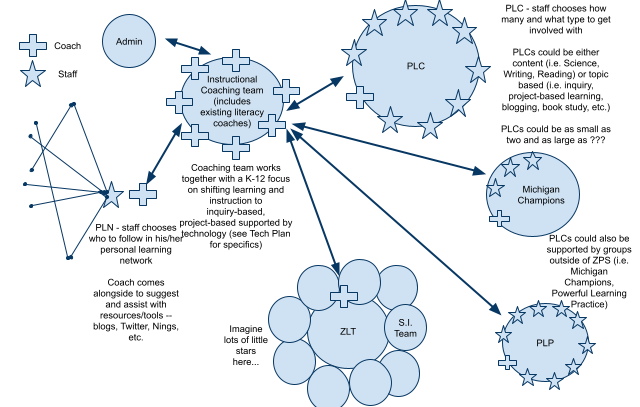
At our tech coach discussion, Steve began by having us view this video by Sheryl Nussbaum Beach of Powerful Learning Practice, a group that facilitates professional development through a "cohort model [that] offers a unique approach to introducing educators to the transformative online technologies that are challenging the traditional view of teaching and learning." Our purpose for watching was to understand the difference between PLCs and PLNs, and then look at how our vision for instructional/tech coaches fits with the two and other existing structures within ZPS.
As my group began to discuss and illustrate our thoughts on chart paper, a drawing similar to the one pictured below began to emerge. Groups then had a chance to share out. The drawing below represents my synthesis of the thinking that was shared that day (in other words, these are not my own thoughts). I am hoping that other ZPS staff who were not present at the coaching meeting will be willing to view and edit the following drawing in Google Docs so we can create a vision for professional learning communities in ZPS as we make the transition to "transformative" learning in conjunction with our roll-out of 1:1 technologies.
27 October 2010
Practicing Empathy
In a recent post, Will Richardson shared a video of a discussion between himself and Lisa Brady, the superintendent of the district he was formerly employed by and where his kids now attend school. It was a great discussion about the challenges and successes of going 1:1 and the realities of introducing social networking. As Will writes, "I think it’s great opportunity to hear a school leader in the midst of shifting a traditional school to a inquiry-based curriculum grounded in technology and online social learning tools talk about some of her thinking around making those changes."
I highly recommend viewing it.
As I've been thinking about the big shift that is occurring and talking about it with colleagues, I'll admit that I don't always remember to practice empathy and put myself in their shoes. In a comment on the same post from Will, Susan Davis wrote the following:
I highly recommend viewing it.
As I've been thinking about the big shift that is occurring and talking about it with colleagues, I'll admit that I don't always remember to practice empathy and put myself in their shoes. In a comment on the same post from Will, Susan Davis wrote the following:
I am struck by your (our) frequent use of the word “shift.” To many, I think it feels more like a quake. Even as a quake, the earth moving under our feet — the change in the way learning is happening in the world — can make us feel excited (hey, that’s cool, I wonder what that shaking means…) or it can feel pretty scary (hey, my house is falling down around me).
This conversation reminds me to feel a little more empathy for those whose educational houses are falling down around them.
When Lisa Brady asks, as if for those scared and shaken folks, “Where’s my entry point?” we can imagine how they are seeing a world where the doors are moving side to side so fast they can’t see beyond them. Still, there is some urgency, the ground is shaking, and they need to get through one of those passages and safely to the other side.
It was a good reminder to me to practice empathy with my colleagues "whose educational houses are falling down around them."
Subscribe to:
Posts (Atom)