Links for my two sessions at ZETA.
Inquiry: Making Thinking Visible
1:10-2:00 pm
Room 110
Building Your Tribe: PLN 101
2:10-3:00 pm
Room 110

12 August 2013
02 July 2013
"Waking from cancer..."
"Waking from cancer, I fell into an unexpected loss of ambition, and the milestones by which I wanted to engrave my image on the world scattered."
- Mark Nepo, Seven Thousand Ways to Listen, p. 47
 |
| Chloe, tubing the Platte River last week. |
My six-year-old daughter, Chloe, was diagnosed with a stage III Wilm's Tumor two years ago this week. Thanks to God, she's doing great.
The changes that the arrival of cancer brought to our family were immense, innumerable, and life-altering. While we would never invite cancer into our family, my wife and I can readily cite hundreds of positive changes that it brought to our family. Life-threatening illnesses have a way of doing that.
Yet, from my vantage point, my working world has never quite recovered. Maybe that's why the quote from Mark Nepo resonated with me this morning. In so many ways I feel like my pre-cancer goals, my milestones, disappeared and I've spent the past two years trying to figure out where I'm headed professionally.
However, I've begun to wonder if it's okay to not know exactly where I'm heading. Maybe it's okay to just show up each day, ready to learn, ready to question, ready to listen. Present to the possibilities.
13 June 2012
"What now?"
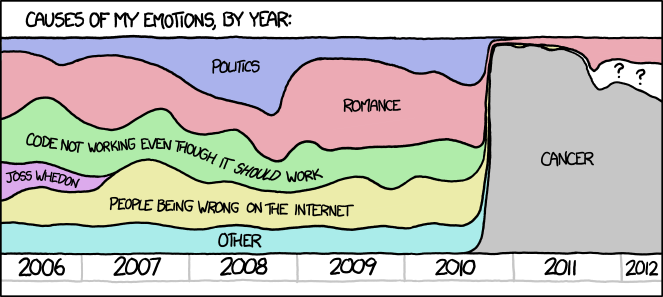
A while back, a friend shared this comic with me.
Substitute a few of the pre-cancer "causes" and shift the arrival of cancer a year forward and it could be my emotions.
As my daughter's chemo treatments wrapped up early in 2012 the white area with the ?? began to grow. Life pre-cancer was just life, it wasn't perfect, but it was. Life post-cancer is different, time feels more precious. (She's doing great, by the way.)
The white space has been filled with a fuzzy attempt to discern where my energies should be spent, what should be my focus, what is worthy of my time now that it feels more precious.
But it's been too much thinking, not enough living. I believe that something new, something amazing, something creative will come out of our family's experience. Yet I'm having a difficult time waiting to see what that something is...
Random stories have appeared out of nowhere to encourage me to just move on, to live, to do.
I recently learned an adventure photographer whose work I've admired for years experienced cancer at a young age and was touched by the way his view of community changed.
A colleague shared how his career path changed following a family tragedy.
Yesterday it was Rob Bell's Drops Like Stars that jumped off the bookstore shelf and resonated in my soul as I read:
I can see that in our family's life, in the way that we've reordered our priorities and the new ways we use our resources of time, energy, and money.
Rob continues with this observation:
 |
| Emotion by xkcd |
As my daughter's chemo treatments wrapped up early in 2012 the white area with the ?? began to grow. Life pre-cancer was just life, it wasn't perfect, but it was. Life post-cancer is different, time feels more precious. (She's doing great, by the way.)
The white space has been filled with a fuzzy attempt to discern where my energies should be spent, what should be my focus, what is worthy of my time now that it feels more precious.
But it's been too much thinking, not enough living. I believe that something new, something amazing, something creative will come out of our family's experience. Yet I'm having a difficult time waiting to see what that something is...
Random stories have appeared out of nowhere to encourage me to just move on, to live, to do.
I recently learned an adventure photographer whose work I've admired for years experienced cancer at a young age and was touched by the way his view of community changed.
A colleague shared how his career path changed following a family tragedy.
Yesterday it was Rob Bell's Drops Like Stars that jumped off the bookstore shelf and resonated in my soul as I read:
Others with far more wisdom and experience than me have tackled the "why" questions of suffering.He goes on to write: "[Suffering] compels us to eliminate the unnecessary, the trivial, the superficial."
Here, in these pages, I'm more interested in another question...
Not "why this?"
But "what now?"
I can see that in our family's life, in the way that we've reordered our priorities and the new ways we use our resources of time, energy, and money.
Rob continues with this observation:
Sometimes what happens to us when we suffer is that we become open to the mercy and grace and gratitude and gift and appreciation and joy that are always around us all the time...While I wait to see "what now?" I'd be content if I could be open to what is, and always has been, all around me.
30 December 2011
Goals for 2012, or the lack thereof
Over the past decade, a friend and I have traditionally written personal goals for the new year and shared them with each other. This year, for a variety of reasons, I'm opting to live without goals.
However, if I were to write goals for the new year, they might go something like this...
Thanks to my beautiful wife for passing this along to me, even though I thought she was poking fun at my need to set goals. :>)
However, if I were to write goals for the new year, they might go something like this...
Thanks to my beautiful wife for passing this along to me, even though I thought she was poking fun at my need to set goals. :>)
06 October 2011
Prayer & Inspiration
"How are you guys doing it?"
I can't tell you how many times my wife and I have been asked that question in the months since Chloe's diagnosis. The answer is simple. You get up, you get going, you get the family going, and just live the day. You don't have a choice.
Actually, I've found there are two things that are making days manageable. Prayer and inspiration.
Prayer is the obvious one. However, I've found there are so many days when it is difficult to quiet my mind and heart and allow the Spirit to enter the moment. Yet it is on those days that others tell me, from seemingly out of nowhere, that they are praying for Chloe and our family. Today is was a colleague during my plan time, over the weekend a parent of one of my students told me that my student prayed for Chloe during Sunday School. Wow.
The inspiration piece is something that evolved as I was trying to expand my circle again. In an effort to get back into my PLN, I began to give myself five minutes a day to explore Flipboard containing my Twitter and Google Reader feeds. Not only did I begin to feel inspired again, I began to want to share that inspiration either through a tweet, an email, or a conversation. A daily ritual had begun. Now each day, without planning or forethought, I carve out a few minutes to be inspired or inspire someone else.
And that, possibly poorly written, is how I do it each day.
27 September 2011
An expanding and shrinking circle
 |
| Circle inversion by fdecomite on Flickr |
When Chloe was first admitted to the hospital this summer, my world, or my circle, shrunk to five people - our family. Many days it was a circle of three as Henri and Martha were cared for by grandparents, aunt and uncles, or family friends.
In the weeks following, it was challenging to expand that circle. It went slowly, sometimes trying to include a few friends from church or colleagues from work. Often times I found myself needing to retreat to my circle of five afterwards to regroup and recharge.
It took at least a month and a half before I was able to expand my circle great enough to include my PLNs via Twitter and Google Reader again. Even then, most of the time it is still as a "lurker" rather than as a participator.
Last week, Chloe had a tough week. A heavy dose of chemo on Monday made her feel cranky, tired, and generally out of sorts for the week. That determined our week as well. Couple that with a lot of assessments within the walls of my classroom and I have found my circle shrinking again.
I wonder if this expanding and shrinking circle phenomenon is just a product of cancer in our family or if it has happened before without my awareness. One more detail that I just need to accept and roll with...
08 July 2011
Prayers for Chloe
Chloe, my four year old daughter, was admitted to DeVos Children's Hospital yesterday and had surgery this afternoon to remove a her left kidney containing a large mass.
Details can be found at our family blog: http://blog.hollandanderson.net
Prayers are appreciated!
Details can be found at our family blog: http://blog.hollandanderson.net
Prayers are appreciated!
15 June 2011
DIY TED Talk
Here's something I'll be pondering this summer, courtesy of Seth Godin in Poke the Box.
If you had a chance to do a TED talk, what would it be about? What have you discovered, what do you know, what can you teach? You should do one. Even if you don't do one, you should be prepared to do one.
15 May 2011
When the going got tough...
...to be honest, I wanted to quit.
Since Christmas Break I've been trying to get back into the running groove. Unfortunately, beginning about that same time, I began to suffer from painful IT band issues. In an effort to keep myself motivated to get out there and pound the pavement, I signed up for the 25K Riverbank Run. A little nutty, I'll admit. Yet I knew that if I didn't have that out in front of me, I probably would have quit. And boy did I want to quit.
On at least three occasions (and probably more), I came home and told Christa that I was done running. It was time for me to be content walking and cycling. She did a great job of just listening, and then usually suggested to take a few days to recover and then try it again.
Towards the end of March when my mileage was about half what it should have been according to my training schedule, I discovered that I had overlooked one possible contribution to my IT band pain: insoles. Even though I replace my shoes on a regular basis, I hadn't replaced my insoles for many (read: around 5!) years. Once I put new insoles in my shoes, the pain started to go away.
 Yesterday, I achieved my goal: I finished my 25K run with a smile on my face. The run was great. Lots of energy, the rain stopped just in time for us to start, and the temperature was perfect. No record time, but I feel great about my effort.
Without going into too many details, I see so many parallels between my efforts to train for my run and the work of the ZPS TPIT. I was reminded of that as I finished up reading Switch: How to Change Things When Change is Hard yesterday afternoon. Two quotes from the final pages resonated with me:
Change isn't an event; it's a process. (p.253)My run yesterday was certainly an event, but it wasn't the change. The change is my getting back into running. Likewise, handing our staff and students new technology in the coming months will be an event, but the technology itself won't create a transformative change. That change is going to be a long process, one for which we will be persistent.
To lead a process requires persistence. (p. 254)
03 May 2011
Am I Googleable?
That's the question that blogger and author Will Richardson would like us to ask of ourselves as educators. In an interview with Education Week from last October, Will shares:
...too few teachers have a visible presence on the Web. The primary reason this matters is that the kids in our classrooms are going to be Googled—they're going to be searched for on the Web—over and over again. That's just the reality of their lives, right? So they need models. They need to have adults who know what it means to have a strong and appropriate search portfolio—I call it the “G-portfolio.” But right now—and this is my ongoing refrain—there’s no one teaching them how to learn and share with these technologies. There's no one teaching them about the nuances involved in creating a positive online footprint. It's all about what not to do instead of what they should be doing.
The second thing is that, if you want to be part of an extended learning network or community, you have to be findable. And you have to participate in some way. The people I learn from on a day-to-day basis are Googleable. They’re findable, they have a presence, they’re participating, they’re transparent. That’s what makes them a part of my learning network. If you’re not out there—if you’re not transparent or findable in that way—I can’t learn with you.
If a student, parent, or colleague were to Google you, what would they find? How are you using online communities to learn and grow professionally?
Join in with us as we all learn what it means to say iLearn@ZPS.
Cross posted to the iLearn@ZPS blog.
Subscribe to:
Posts (Atom)